
Natural vs Lab Grown Diamonds

Lab-Grown vs Natural Diamonds: An Honest Guide from a Master Jeweller
Manufacturing Jeweller | Managing Director, Martin Rogers Jewellers
Jump To
Every week I sit across from people who are about to make one of the biggest purchases of their lives. They arrive asking about lab-grown diamonds and natural diamonds. They leave talking about something far more important….. trust.
The conversation surrounding diamonds has become increasingly confusing. One article tells you lab-grown diamonds are the only ethical choice. Another tells you natural diamonds are the only worthwhile investment. Social media is full of opinions, advertisements and headlines, yet very little balanced information.
That is why I wanted to write this guide.
I haven't written it to convince you to buy one particular type of diamond. In fact, if a lab-grown diamond genuinely suits your priorities and your budget, I believe that's a perfectly valid choice. What matters to me is that every client understands exactly what they're buying before making such an important decision.
For more than twenty-five years I've worked as a manufacturing Jeweller, designing and handcrafting bespoke jewellery. Every piece we create is independently valued because integrity has always mattered more to me than making a sale. My hope is that this guide gives you the information to make a confident, informed decision…. whatever that decision may be.
What Is a Lab-Grown Diamond?
The first thing people ask is whether a lab-grown diamond is a real diamond.
The answer is yes.
A lab-grown diamond starts with a tiny diamond seed. From there it is grown using either High Pressure High Temperature (HPHT) or Chemical Vapour Deposition (CVD). One process recreates the immense heat and pressure found deep beneath the earth's surface. The other gradually deposits carbon, layer by layer, until a crystal forms…almost like three-dimensional printing using carbon atoms.
Chemically, physically and optically, a lab-grown diamond is still a diamond.
The real difference is not whether it is genuine, but how and where it was formed.

Why Natural Diamonds Continue to Fascinate Me?
Natural diamonds have a romance that, for me, can never be manufactured.
Imagine a
crystal forming around one hundred and sixty kilometres beneath the Earth under extraordinary heat and pressure for between one and three billion years. Every excepti
onal natural diamond is the result of almost unimaginable geological conditions coming together perfectly.
People often say diamonds aren't rare. In one sense they're right. Industrial diamonds are used every day. But exceptional gem-quality diamonds are genuinely rare, and the larger and finer they become, the rarer they are.
Some of the diamonds we work with are among the finest available, including D Flawless Type IIa diamonds. To find a diamond that has remained exceptionally pure over billions of years is remarkable.
Even after all these years, I never get tired of looking at beautiful diamonds. Their brilliance, purity and story continue to captivate me.
Are Lab-Grown Diamonds Really the Ethical Choice?
One of the biggest misconceptions I encounter is that lab-grown diamonds are automatically the ethical option.
I understand why many people believe that. They are often described as 'mine-free', but I believe the reality is much more complex.
While the diamond crystal itself is grown in a laboratory, the production process still relies on mined raw materials, specialised manufacturing equipment and significant amounts of energy. The environmental impact depends on where and how that energy is generated.
Natural diamonds, meanwhile, come from an industry that has evolved considerably over recent decades. Reputable producers participate in the Kimberley Process and many invest in environmental rehabilitation, local employment, healthcare and education.
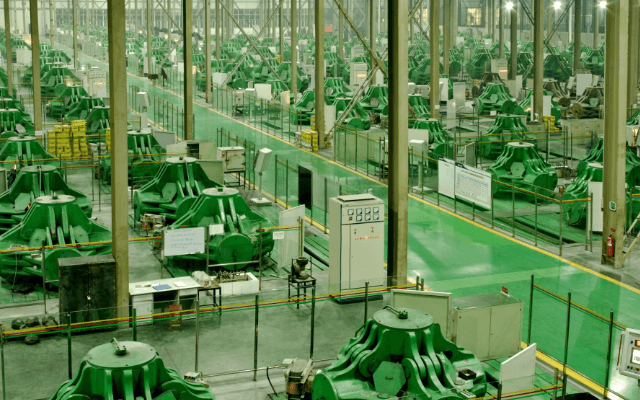
Rather than accepting simplified marketing claims from either side of the debate, I encourage clients to ask questions and understand the entire picture before making a decision.
Are Lab-Grown Diamonds Better Value?
Lab-grown diamonds are unquestionably less expensive than natural diamonds, but lower purchase price doesn't automatically mean better value.
When lab-grown diamonds first entered the market they sold for around half the price of comparable natural diamonds. As manufacturing technology has improved, production costs have fallen dramatically.
My concern isn't that lab-grown diamonds exist. My concern is that many consumers don't realise how quickly wholesale pricing has changed. I believe every buyer deserves to understand today's market and how future pricing may affect replacement values over time.
Transparency is essential. Whatever you choose, you should understand why it costs what it does and what you're receiving for your investment.
How I Help Clients Choose
I never begin by asking whether someone wants a natural diamond or a lab-grown diamond.
I begin by asking what matters most to them.
Is it size? Budget? Ethics? Rarity? Long-term ownership? Family legacy?
Every client values something different, and that's where the conversation should begin.
If someone loves the idea of a natural diamond but worries about affordability, that's where experience becomes invaluable. By carefully balancing the Four Cs—cut, colour, clarity and carat weight—we can often achieve a significantly larger, more beautiful diamond without paying for characteristics that add little visible benefit.
Buying a diamond is only about finding the right stone for the client in front of me.
Why Trust Still Matters
People don't just choose a diamond. They choose the jeweller they trust.
For centuries, families had a family jeweller. Just as they had a family doctor or solicitor, they relied on someone who understood their history, their tastes and the significance of the pieces they owned.
That tradition still matters to me.
Martin Rogers Jewellers was founded more than forty years ago on craftsmanship, honesty and relationships. After more than twenty-five years in the trade, I'm now creating anniversary gifts for couples whose engagement rings we made decades ago, and increasingly I'm privileged to make engagement rings for their children.
Those moments remind me that trust isn't earned in a single transaction. It's earned over generations.
That's why I'd rather educate than sell. If a client leaves our workshop with a better understanding of diamonds—even if they choose to buy elsewhere—I've still done my job with integrity.
Why Bespoke Is the Ultimate Luxury?
Luxury isn't about owning the most expensive piece in the room.
To me, luxury is having something made especially for you.
Every person is different. Every relationship is different. The jewellery that marks those moments should reflect that individuality.
I still sketch designs by hand. I still work through every detail with my clients. I still handcraft jewellery because I believe that the process matters just as much as the finished pi
ece.
A bespoke ring tells a story that can't be found in a display cabinet. It becomes part of the family's story from the day it is created.
What Jewellery Has Taught Me About People
After more than twenty-five years, I've realised jewellery has never really been about jewellery.
It's about emotion.
We've celebrated engagements, weddings, anniversaries and the arrival of children. We've watched young couples become grandparents. We've restored treasured heirlooms and remodelled wedding rings after the loss of a husband or wife so that they can continue to be worn in a new way.
We've restored precious keepsakes that have remained in families for centuries. We've incorporated the ashes of loved ones into jewellery. We've helped preserve memories that simply couldn't be replaced.
When I began my apprenticeship, I thought I was learning to make jewellery.
What I was really learning was how much trust people place in us during the most significant moments of their lives.
The stories of people live on through the jewellery.
For me, that's the greatest privilege of being a jeweller.
Frequently Asked Questions
Are lab-grown diamonds real?
Yes. Lab-grown diamonds are chemically, physically and optically diamonds. The key difference is how they are formed.
Which is better, lab-grown or natural?
Neither is universally 'better'. The right choice depends on your priorities, budget and what matters most to you.
Do lab-grown diamonds sparkle differently?
No. When cut well, both natural and lab-grown diamonds display the same fundamental optical properties.
Can I buy a beautiful natural diamond on a budget?
Absolutely. Careful selection of the Four Cs often allows clients to maximise beauty without paying for characteristics that may not be visible to the naked eye.
Why is independent advice important?
Because buying a diamond is a significant decision. A trusted jeweller should help you understand your options rather than simply steer you toward one outcome.
Final Thoughts
If there's one thing I'd like you to remember, it's this:
Don't buy a diamond because of a slogan.
Don't buy one because of a trend.
Buy it because you understand it.
Ask questions. Learn about your options. Find a jeweller who values honesty as much as craftsmanship.
Whether you ultimately choose a natural diamond or a lab-grown diamond matters less than making a decision that reflects your own values, your budget and your story.
If this guide has helped you ask better questions, then it's achieved exactly what I hoped it would.
At Martin Rogers Jewellers, we'd be honoured to have that conversation with you.
Contact Us
Email: info@martinrogers.com.au
Phone:(08) 8364 3244